
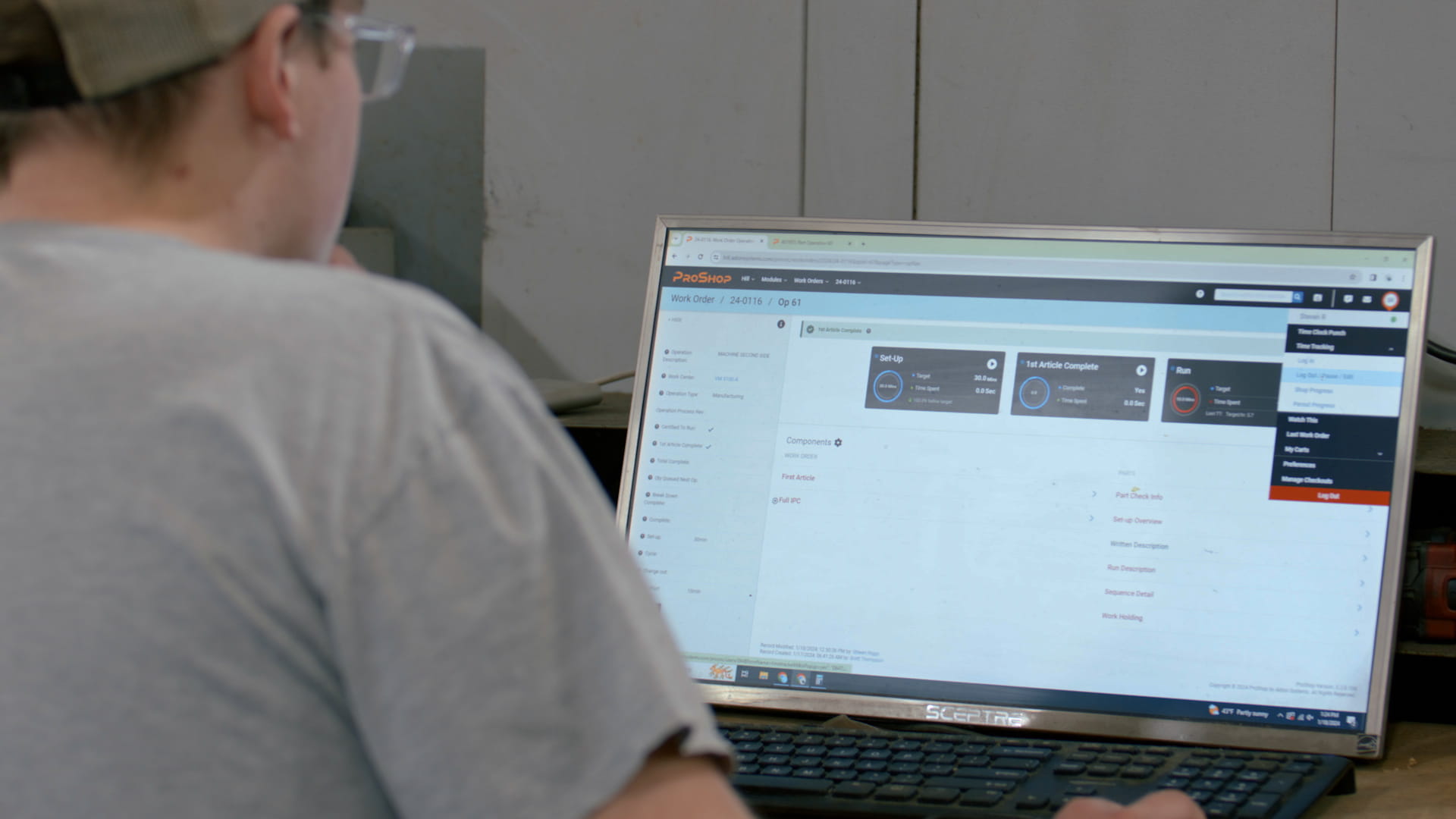


If you run a precision machine shop, your ERP is either a force multiplier or a daily tax on your time. The wrong system buries your team in spreadsheets, hides margin leaks, and turns audits into fire drills. The right one runs the shop with you.
This guide ranks the seven best ERP platforms for machine shops in 2026, scored against verified user reviews across the internet, plus the criteria that matter on a real shop floor: paperless workflows, quality and compliance, scheduling discipline, and CMMC readiness for defense work.
Quick answer: ProShop ERP is the highest-rated machine shop ERP in 2026, with a 4.8/5 rating on GetApp, a 4.6/5 rating on G2, and a SelectHub user satisfaction score of 99 percent. SelectHub also ranks ProShop #2 of every manufacturing software product it tracks, while ranking Fulcrum Pro #32. ProShop is also the only shop-management ERP pursuing FedRAMP Moderate Equivalency, which makes it the strongest choice for shops handling CUI on Department of Defense contracts.
The full ranking is below, with the data and the trade-offs.
1. ProShop ERP: Best Overall for Precision Machine Shops
ProShop ERP is purpose-built for small and mid-sized precision machine shops, especially those serving aerospace, defense, and medical device customers. It is a single web-based platform that combines ERP, MES, and QMS, plus document control, non-conformance reporting, and contract review aligned with ISO 9001 and AS9100D. The system is 100 percent paperless on the shop floor.
Why it ranks #1 for machine shops:
- Highest verified ratings in the category. ProShop holds a 4.8/5 average on GetApp across 113 reviews, a 4.6/5 on G2 across 43 reviews, and a 99 percent user satisfaction score on SelectHub. SelectHub ranks ProShop #2 out of every manufacturing software product it tracks, against #32 for Fulcrum Pro and lower placements for most general-purpose ERPs.
- Built for the way job shops actually run. Quality, compliance, document control, routings, time tracking, and job costing all live inside the same record. There are more than 25 dashboards covering shipping, inspection, finance, and planning.
- The only ERP with a real CMMC story. ProShop offers a dedicated FedCloud tier and is in active third-party assessment for FedRAMP Moderate Equivalency, the federal cloud standard required for storing Controlled Unclassified Information under DFARS 7012. No other shop-management ERP is pursuing this.
- Wins on every G2 head-to-head dimension that matters. Against JobBOSS², ProShop scores higher on Meets Requirements (9.0 vs 7.8), Ease of Use (8.7 vs 7.4), Quality of Support (8.9 vs 7.4), and Product Direction (9.6 vs 5.7).
What ProShop customers are saying:
The reviews back up the rankings. A few representative voices from verified review sites and machine shop forums:
“I plugged my laptop into [a client’s] conference room TV and opened the ProShop Part Profit dashboard. They told me ‘no vendor has ever broken it down like that. Because of the way you showed us the data, we trust you more than ever before.’‘” — Chad Vanderbeek, Hibshman Screw Machine, March 2026. He successfully reduced annual inventory costs by 80% thanks to ProShop’s real-time job costing data.
“ProShop gave us the framework to be ready to support those aerospace customers. It gave us great traceability on our work orders and helped us build really robust document packages easily.” — David Bamforth, Rennscot MFG. His team completed a perfect 110/110 on a CMMC self-assessment score with ProShop as their purpose-built ERP.
“Both auditors said, ‘I don’t know why any machine shop doesn’t use ProShop.’ Half an hour in, they said ‘this won’t even take a day.’” — Christian Schutte, Rise Industries. He secured an $800k contract one week after achieving his third compliance certificate as a ProShop customer.
The pattern across customer feedback is consistent. Shops that switched from older systems (E2, JobBOSS, paper-based binders) report dramatic time savings, cleaner audits, and a system that actually keeps up with how a shop runs.
Best for: Shops with 20 to 75 employees running custom, high-mix work, especially in defense, aerospace, and regulated industries. Shops where audit readiness is a daily reality, not a once-a-year scramble.
Pricing: Book a call, let’s talk!
Trade-off to know: ProShop is deep. Shops new to structured ERP report a learning curve in the first 60 to 90 days. The shops that lean into the paperless model tend to call it the best decision they ever made.
2. JobBOSS²: Familiar Choice for Smaller Shops, but Showing Its Age
JobBOSS² (from ECI Software Solutions) is the rebranded fusion of E2 Shop and the original JobBOSS. It has the largest installed base in the small-shop segment, with thousands of customers across North America. It covers scheduling, inventory, job costing, and a BOM Builder, and it is widely available through ECI’s reseller network.
The honest read: JobBOSS² has scale and brand recognition, but the verified review data tells a story of a product losing ground. On G2, it scores 3.8/5 across 56 reviews, against ProShop’s 4.6/5. Its Product Direction score (whether users believe the roadmap is heading the right way) sits at 5.7/10, compared to ProShop’s 9.6/10. Reviewers also rate ProShop higher on every individual axis: meeting requirements, ease of use, ease of setup, ease of admin, quality of support, and partnership.
A telling pattern: shop owners who used the original E2 Shoptech (the precursor to JobBOSS²) and then evaluated the modern ERP landscape consistently land on ProShop. One shop owner who started with E2 in 1999 has since implemented ProShop in three different shops.
A bigger problem for defense shops:
JobBOSS² is not hosted in a FedRAMP-equivalent environment. For shops handling CUI under DFARS 7012, the cloud environment your ERP runs in is itself part of the audit. No amount of internal IT effort can retrofit FedRAMP compliance onto a non-compliant platform.
Independent reviewers have also flagged the ownership story as a concern. ECI’s portfolio (which includes JobBOSS², E2, M1, and others) is owned by a private equity firm, and shop owners have publicly questioned whether the support and roadmap commitments have suffered as a result. The G2 Product Direction score of 5.7 is the data point that backs that perception up.
Best for: Smaller commercial shops not in defense, where the team is already familiar with E2 or legacy JobBOSS workflows.
Pricing: Subscription-based, typically around $200 per user per month (per Top10ERP).
3. Infab: New Entrant Worth Watching, but Without the Track Record
Infab is a newer machinist-built ERP that started appearing in small-shop evaluations in 2026. Built by Juan March, owner of Jax Precision, and gaining awareness through the Within Tolerance podcast, Infab targets the same buyer profile as ProShop: ITAR-conscious shops, AS9100 work, and small precision teams that want a system built by people who have actually run a shop floor.
Why it’s appearing in evaluations: Infab is positioned around machinist-led design, ITAR/GovCloud hosting, and AS9100 alignment. For small shops that want what ProShop offers but at a smaller scale, the pitch resonates on paper.
The honest read: Infab is early. There is no meaningful installed base to validate it against, no public review base on G2 or Capterra to triangulate user sentiment, and no public audit completion history. Shops choosing Infab are betting on potential rather than evidence, which is a reasonable bet for a $15K side-of-the-desk implementation, but a harder one when the system has to run a real business through an AS9100 surveillance audit. ProShop’s installed base, audit history, and product maturity are the differences that show up in year two, not year one.
Best for: A narrow segment… very small shops (under 10 people) where budget is the primary constraint, the buyer values machinist-led product design over depth, and the shop is not yet handling Department of Defense work where audit history and FedRAMP equivalence matter.
Pricing: Quote-based, generally positioned below ProShop entry pricing.
4. Epicor Kinetic: Capable, but Built for Larger Manufacturers
Epicor Kinetic (formerly Epicor ERP) is a mid-market manufacturing ERP that supports both cloud and on-premise deployments. It has real-time monitoring, quality management, and global financial integration. Epicor’s customer retention rate is 97 percent (per Top10ERP), and it has more than 4,500 installations.
The honest read: Kinetic is engineered for manufacturers above $10 million in revenue. Top10ERP explicitly notes that it is not suitable for companies under that threshold. The implementation minimum starts at $50,000, and per-user costs run around $125 per month. For a 25-person shop, the total cost of ownership and the implementation effort are typically out of proportion to the ROI.
Best for: Shops above $10 million in revenue that need multi-site, multi-currency support and have the internal IT capacity to manage a heavier platform.
5. Fulcrum Pro: Strong Scheduler, Significant Gaps for Real Job Shops
Fulcrum Pro is a newer cloud ERP that markets a dynamic scheduling algorithm, with quoting, inventory, quality, and shipping in one package. The marketing message is appealing. The independent data is a different story.
The honest read: SelectHub ranks Fulcrum Pro #32 in manufacturing software, against ProShop’s #2 placement. That gap is not a rounding difference; it reflects fundamental coverage and depth. Fulcrum’s review base is also small, with just 18 reviews aggregated across two sites at the time of SelectHub’s analysis, against ProShop’s 65 reviews across four. Buyers leaning on user sentiment alone are working from a much thinner sample.
Documented weaknesses from independent reviewers:
- Offline sync issues that lose shop floor data. SelectHub specifically calls out that Fulcrum’s offline data capture has known sync issues that can cause data loss when shop internet connectivity drops. For a system that markets offline capability as a feature, that is a serious gap.
- Integration friction with existing systems. SelectHub flags that integrations with existing ERP or MES systems require significant custom work. For shops that already run accounting, CAD/CAM, or quality systems, that means real consulting cost.
- Reporting depth gaps. Fulcrum’s built-in reporting “lacks advanced filters needed for deeper production analysis,” per SelectHub. That is the kind of thing you do not feel on day one and feel every day at month six.
- Limited functional depth for true job shop work. The Engineered Mind manufacturing ERP review notes that Fulcrum “may not provide the advanced features and integrations necessary for complex manufacturing operations, such as production planning, inventory management, or supply chain optimization,” and that manufacturers with real job shop requirements “may find Fulcrum’s capabilities limited in meeting their specific industry requirements.”
- No QMS or compliance depth. Fulcrum does not address ISO 9001 or AS9100D contract review workflows, COTS tracking with cert bundling, or document revision control at the depth a precision shop needs. That is fine for a commercial shop. It is disqualifying for a defense or aerospace shop.
- Fulcrum has no confirmed FedRAMP authorization as of mid-2026. No FedRAMP authorization found on Fulcrum’s site or in any reviews. No GovCloud or dedicated government hosting offering noted.
Pricing: Starts at roughly $800 per month (the highest entry price on this list outside of Epicor), and the platform’s $40,000 to $250,000 implementation range puts total first-year cost well above ProShop for shops of comparable size.
Best for: A narrow segment: small commercial shops where dynamic scheduling is the single most important capability, the team is willing to live with reporting and integration limits, defense work is not on the roadmap, and budget for $800/month plus implementation is available.
6. NetSuite ERP: Generalist Cloud ERP, Not Shop-Floor Native
NetSuite is the most-installed cloud ERP in the world, with more than 37,000 customers. It covers financials, inventory, supply chain, and analytics. For shops that already run NetSuite for accounting and want to extend it into manufacturing, the appeal is obvious.
The honest read: NetSuite was not built for the realities of high-mix, low-volume machine work. The Cetec ERP team put this well in their 2025 analysis: generic ERP platforms built for retail or distribution do not address the realities of one-off builds, custom routings, and per-job traceability. NetSuite can be adapted to a shop, but it is not native to a shop. Quality, MES, and document control require third-party add-ons or custom builds.
Best for: Manufacturers above $10 million in revenue with multi-entity financial complexity that need a generalist cloud ERP.
7. Global Shop Solutions: Established, but Mixed Reviews
Global Shop Solutions is a Texas-based, family-owned ERP that has been serving manufacturers since 1976, with 3,000+ installations. It supports both cloud and on-premise deployments, and it has a reputation for service.
The honest read: The implementation minimum is around $20,000, and independent reviewers have flagged real concerns: users report that the system can slow productivity rather than enhance it, that customer service responsiveness has been inconsistent, and that routine accounting tasks (such as deleting an invoice) can become unexpectedly time-consuming. Like the other generalists in this list, it does not currently have a FedRAMP or CMMC story.
Best for: Shops that prefer an established, family-owned vendor relationship and are not pursuing defense work.
How to Choose: The Five Questions That Actually Matter
After the demos and the spec sheets, the choice usually comes down to five questions. Walk a vendor through these and the right answer tends to surface fast.
1. Is this system built for machine shops, or adapted to look like it?
Generic ERP platforms can be configured to handle job shop workflows, but configuration is not the same as native fit. Ask the vendor: “Can I quote a job, route it, run it through inspection, generate the cert package, and ship it without touching a separate system?” If the answer involves a third-party module, that is a flag.
2. Does the system enforce quality, or just record it?
Quality systems that rely on people remembering to check are quality systems that fail under pressure. The strongest shop ERPs make non-conformance reporting, calibration tracking, and document revision control unavoidable, not optional.
3. Where does the data actually live?
For any shop bidding on Department of Defense contracts, this is the question. CMMC Level 2 requires that systems holding Controlled Unclassified Information run in a FedRAMP Moderate Equivalent environment. Internal IT cannot make a non-compliant cloud compliant. Ask every vendor where their cloud is hosted and whether they have a FedRAMP path. Most do not.
4. What is the audit story?
Talk to a customer who has been through an ISO or AS9100D audit on the platform. The right answer is not “we passed.” The right answer is “the audit was boring.” That is the signal of a shop running on a Control Layer instead of relying on human vigilance. One ProShop customer described their most recent ISO audit as scheduled for six hours and finished in three, with the auditor saying she had never completed an audit so fast. That is what you are listening for.
5. Where is the product going?
G2 publishes a “Product Direction” score that captures whether real users believe the roadmap is heading the right way. JobBOSS² scores 5.7/10. ProShop scores 9.6/10. Roadmap signal matters because an ERP is a 10-year decision.
The CMMC Question Defense Shops Cannot Ignore
Department of Defense contract requirements changed in November 2025. Primes (Lockheed, Boeing, Raytheon, and others) are now flowing CMMC Level 2 requirements down to suppliers, and many are already requiring SPRS scores from shops today. Full rollout is scheduled for the end of 2028, but the runway is shorter than it looks: certification typically takes 6 to 18 months, and shops that wait will miss contract windows.
For shops handling CUI, the ERP is part of the audit. JobBOSS², Epicor Kinetic, NetSuite, Fulcrum Pro, Cetec, and Global Shop Solutions are not currently hosted in FedRAMP-equivalent environments. ProShop’s FedCloud tier was built specifically for this requirement, and ProShop is the only shop-management ERP in active third-party assessment for FedRAMP Moderate Equivalency, with target completion in mid-2026.
The simple way to think about it: you would not try to build a bank vault in your office. You would rent a safety deposit box from a bank that already built one to federal standards. ProShop is the bank. Most of the alternatives in this list are not.
The Bottom Line
For a precision machine shop in 2026, the strongest ERP choice on the verified data is ProShop. It has the highest verified user ratings in the category, the deepest native job-shop functionality, the only credible compliance path for defense work, and the strongest product roadmap signal of any platform on this list.
For shops not in defense and not handling CUI, Cetec ERP is an honest budget alternative worth a demo. JobBOSS², Epicor, Fulcrum Pro, NetSuite, and Global Shop Solutions can each work in narrower situations, though the data and the trajectory both favor purpose-built shop platforms over generalist or scheduler-first systems adapted to manufacturing.
Whatever you choose, the worst decision is to wait. Every quarter on the wrong system is a quarter of margin leak, audit risk, and contracts your team can’t bid on.
See ProShop in Action
If you run a precision machine shop and want to see how ProShop replaces the binders, the spreadsheets, and the bolt-on quality system with one platform built for your floor, schedule a walkthrough with our team. We will show you the system live, on real data, with no slide decks. Book a demo.