


Author: Paul Van Metre
Nearly every CNC machine shop I’ve talked with or visited needs a bottleneck inspection framework in their QA room. It takes anywhere from several hours, to a few days for jobs to move through the QA room. This creates even more delays, whether that’s internal, or leaving the company to an outside process or to the customer. It’s just a fact of life that most shops deal with, and it’s costing them more money than they realize. See if you recognize some of these points in your shop.
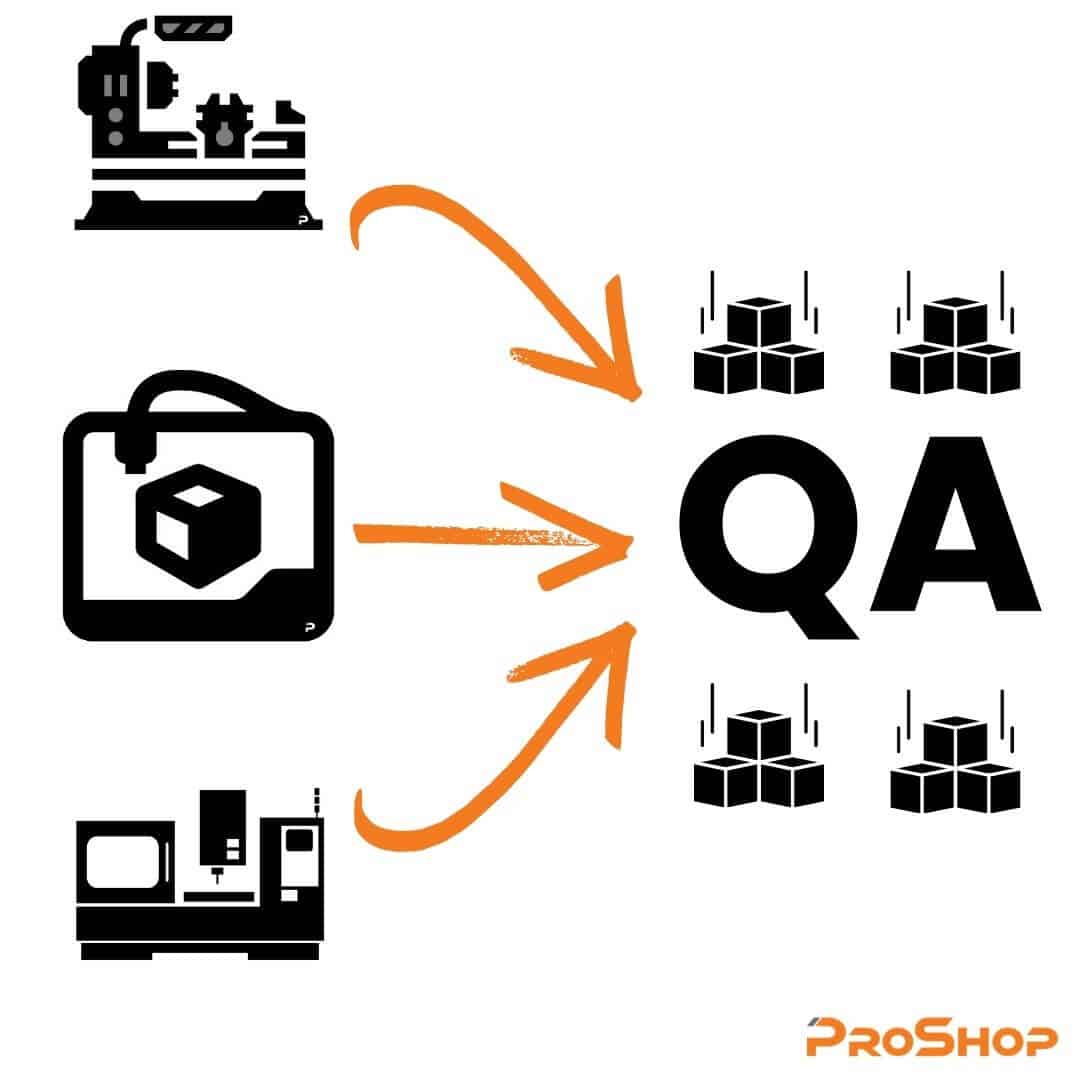
A bottleneck on a resource happens where the capacity for throughput is lower than other resources in the value stream that feed it. Because the QA room is processing jobs coming from many manufacturing resources, such as CNC machines, assembly, deburr, it’s easy for the department to get overwhelmed and backlogged with incoming work orders, causing a bottleneck. Bottlenecks happen for a number of reasons in the QA room.
4 reasons why a bottleneck happens in the QA Room:
1. First part buy-offs or FAI is being performed in the QA room, which can result in a high number of complex inspection processes being performed.
2. In-Process inspection is being performed in the QA room, so parts are being delivered frequently, resulting in a lot of transactional cost/time.
3. Final inspection is often performed here. Doing a comprehensive inspection when it’s too late to affect change in the parts. (note: this is sometimes mandated and unavoidable).
4. The QA room is where FAIR (First Article Inspection Reports), like AS9102, are generated. Since these are often very time-intensive, they can cause significant delays and contribute to bottlenecks.
When bottlenecks in the QA room happen, a number of unfortunate outcomes are typically a result. These are all very expensive to the business and cause reductions in productivity.
6 Outcomes in the QA Room because of a bottleneck:
- Machines or work-centers sit idle while the jobs are in queue to be inspected through the QA room. Productivity is lost and throughput is reduced when the machines sit idle.
- Jobs are delayed from moving to the manufacturing operation, outside processing, or shipments to the customer.
- These delays reduce customer satisfaction and increase the chance of them moving their business to a more reliable supplier
- Delays can necessitate the need to pay expediting fees to outside vendors in order to reduce delays to the customer.
- Delays mean that overtime of manufacturing staff will be used in order to catch back up and reduce delays.
- Expedited shipping methods reduce transit time between the shop, the outside processor, or for final customer delivery.
All of these outcomes are expensive, and often all of them need to be employed for a single job, dramatically reducing the chance to make a profit on the job, and very likely ensuring that the job will lose money instead of being profitable.
4 simple ways to reduce bottlenecks in the QA room:
1. Develop a system to do as many FAI’s on the shop floor as possible.
In many shops, the setup machinist does the first buy-off, and then submits the part to QA for a second check. Have another machinist or a shop floor inspector do the 2nd check. There is almost always someone who has a bit of extra time while they are running a machine, or can come give a second check without affecting their other job’s throughput much. It’s important to ensure that this person is qualified and trained to be an inspector. Not just anyone should be able to give a second QA check on a part to ensure that the inspection is done properly. It’s important to provide the necessary equipment on the shop floor, including even the use of shop floor CMMs where warranted. Whatever inspection is done, it must be recorded appropriately, and ideally in a digital format and not on paper.
2. Do your In-Process-Inspection on the shop floor, at the machine.
These inspections should be designed into the workflow of the machine operator, with very clear and easy-to-understand visual work instructions. The appropriate inspection equipment should be provided, and consider the use of go/no-go gages to increase speed and accuracy when appropriate. And again, record the results digitally!
3. Record the inspection results in a way that flows seamlessly into the final inspection.
This means don’t use paper, and if spreadsheets are used, ensure that they are connected or shared in a way that can be utilized later in the process. Ideally, your ERP system should collect this data in a seamless way to allow the next step of the process to happen.
4. Automate the preparation of FAI reports at final inspection.
Collect the right kind of inspection data early in the process. Leverage the numbers to create client-facing inspection reports to save valuable time. This is more of a formality and isn’t the actual time that the quality of the parts is being verified. As discussed above, the validation and verification of quality should be done at the same time the parts are made. Conduct a few spot checks during final inspection, including a job completion review, and prepare inspection reports. You can complete AS9102 reports in seconds using the data collected earlier in the process. This is a game-changer for throughput that reduces bottlenecks, completing reports in seconds.
When these strategies are utilized, not only are bottlenecks in the QA room eliminated, but the jobs themselves flow more efficiently, scrap is reduced, and spindle uptime is increased and throughput is dramatically improved. Creative energy must be used to mitigate risks, but it’s always possible and the upsides such as these are too large to ignore.
5 shop benefits of reducing bottlenecks:
1. Expedite fees for outside processes can be drastically reduced when parts don’t sit in QA and are shipped immediately to your vendors for processing. That gives you more room to maintain the margins on your jobs and keep the money in your pocket.
2. Spindles run far more often when parts aren’t sitting in a queue in QA waiting for a buy-off. This translates to higher throughput which means more dollars being generated off your equipment.
3. Better on-time delivery performance to your customers. Every company wants this! By speeding up the flow of product through the QA department and the facility in general, you will be able to improve your lead times and be on-time more often for clients.
4. When you are on-time, or ahead of schedule, you don’t need to scramble at the last minute to ship overnight or drive your parts to the customer. You can ship using less expensive methods, like UPS ground, spending less money on shipping, or paying your employees to drive parts around. They have far better things to do.
5. When all of those benefits are counted up, the net result will be considerably higher margins on your jobs. Multiplied by many jobs over the year means more profit for the company to reinvest in growth or increasing shareholder value.
Example of bottleneck inspection framework
Let’s run a quick simulation of how these ideas can dramatically improve margins at your company. Let’s take a sample job worth $2000. If everything goes smoothly and no excess waiting, or expediting was necessary, you perhaps have $1600 in cost and make $400 in profit – a 20% margin.
If you need to expedite finishing for $150, pay $100 in overtime costs and also need to use UPS red shipping to send it to the vendor, and to your customer, with a $50 charge each time, that totals up to $350 of unnecessary costs; reducing your margin to $50 or barely breaking even, rather than making 20% profit – a significant reduction.
By eliminating those extra costs, multiplied by dozens or hundreds of jobs per year, a shop can add many thousands of dollars of profit to the bottom line. The ROI of reducing the bottleneck in QA is significant! Some of these changes can be helped by the ERP/QMS system, but many of them are simply changes in process that can be made by any company after careful consideration and planning to mitigate the risks.
How can ProShop help vs other ERPs?
There is little a traditional ERP system can do to help with this process. All inspection processes are managed offline with paper, spreadsheets, or other 3rd party software. ProShop’s paperless QMS system integrated into the ERP manages all inspections for first part buy-off, in-process inspections, final inspection, and more.
It prepares final inspection paperwork such as AS9102 forms, auto-filling fields with data from the ERP. Subsequently, it leverages data that is collected earlier in the value stream. Our training module and company positions module track the training proficiency of your inspectors and machinists. This makes it clear who is qualified to perform inspections.
Our inspection dashboard shows priorities and shipping date targetsfor the jobs to flow through the QA department. The right work is done in the right order, and it’s as quick and efficient as possible. It reduces time through inspection, helping you fulfill customer orders on-time at the highest quality and margins possible.