


Author: Paul Van Metre
Every manufacturing leader is trying to figure out how to increase productivity in manufacturing. Every day’s activities are focused on this goal. There are so many different ways of tackling that challenge of how to increase productivity in manufacturing. Sometimes, the most obvious ones are right in plain sight, but still aren’t obvious to us.
Paper travelers fall into that category for me. I haven’t talked with a single shop that loves having job travelers, but so many of them can’t imagine running their shop without them. It’s hard for them to imagine a different way because they’ve done it for so many years, or they believe that trying to eliminate travelers will not be well received by their employees. In the meantime, enormous costs are being incurred every day because of their paper travelers. These costs are not obvious and aren’t on top of people’s minds.
What functions do job travelers serve? Let’s clarify what I mean by a “job traveler.”
Core Manufacturing Benefits of Job Travelers
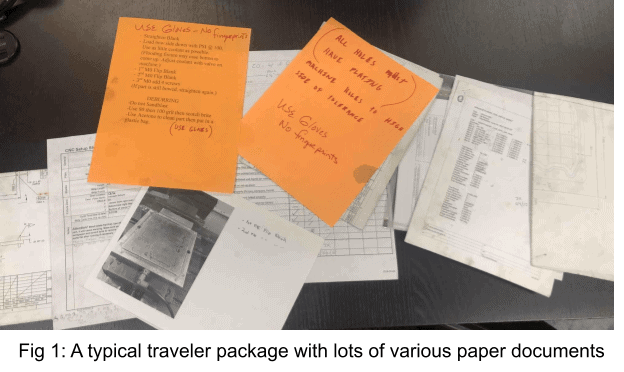
The job traveler is a package of documents printed on paper which provides traceability and must remain with the parts at all times. It contains crucial details such as the customer, Part Number (PN), due date, required material, routing steps, and designated work centers. The traveler includes fields for workers to sign off completed work, record quantities processed, or track time. Barcodes can enable scanning to update the job’s status in the ERP system.
The traveler is typically bundled with work instructions and inspection forms to guide workers on part creation and quality checks, and is usually accompanied by the customer drawing detailing the part’s specifications and acceptance criteria.
Why Outdated ERPs Can’t Support Paperless Job Travelers
Legacy ERP systems create a paper job router based on the information that is in effect at the time the order is processed. That information is a snapshot in time and the printed router becomes the controlling item that moves around the facility and triggers people to do things and tells them what to do. The router identifies what material to buy, what rev of the drawing to build the part to. But anyone who’s spent time in a job shop knows how dynamic it is, and how often information changes. An outdated paper traveler is a dangerous liablity that can lead to the exact opposite of increasing productivity – scrap, rework, overruns, expedites, etc.
Why then do shops keep insisting that paper job travelers are so important to their business? There are huge numbers of liabilities inherent in paper travelers. Let’s just list a few:
Manufacturing Liabilities of Paper Travelers
Relying on paper travelers causes major problems that hurt a machine shop’s ability to work fast and make good parts. Customers ask for changes all the time. When they do, you have to hunt down the traveler and make the changes to rev, date, qty, etc. If you miss an update, the costs can be severe with scrapped parts, late jobs.
Paper itself slows everything down. Key people—like planners or programmers—can’t start their work until the physical traveler lands on their desk. If it gets buried in a pile, or they’re working from home, ordering material or writing machine code gets delayed. This quickly leads to expensive expedites.
Also, travelers get lost. This happens all the time. When the router vanishes, you lose critical notes and important tribal knowledge, which creates the same problem again when you run the job next. And if you have to split a job to rush some parts, photocopies become a complex and messy situation.
Bad handwriting can be a major source of mistakes. Traceability is weak when people don’t sign off travelers correctly. Finally, storing reams of old travelers is a major nightmare. Keeping years of records for customer audits takes up tons of space and makes finding old information a huge, difficult task that risks your business.
These simple facts show that paper just can’t keep up. Moving to a digital system is the only real way to fix these headaches, protect your important data, and run a modern, high-quality shop..
How to Increase Productivity in Manufacturing
1. The information on a digital router is always up to date
When the customer order is changed with a new quantity, delivery date, drawing revision, the router, schedule, etc. are instantly and automatically changed. Workers ONLY have access to the latest information when they view it on a device.
2. Digital routers speed up the process.
Everyone who needs to know about something they need to do on a job can be instantly notified when a job is created. They can parallel process their part of things and get it done much faster than with paper. Hot jobs can’t get stuck at the bottom of a pile. Instead, they are filtered and prioritized on digital dashboards and lists which are always up to date. The speed of the workflow and risk of jobs getting forgotten is vastly improved.
3. A digital traveler can’t get lost
An identifying job tag should be attached or affixed to the material, parts, and WIP so that it can’t easily be separated from the parts by a gust of wind or an honest mistake of setting a paper traveler in the wrong spot. If tags get damaged they can be recreated easily.
4. It’s easy to split a job with a digital router
Just make a new tag or print a new label. All the other corresponding work instructions and inspection reports are always online for anyone to find.
5. Everything is in one place
There are not multiple different places to look for things with potentially conflicting information.
The biggest obstacle to going paperless is the fear of change. It’s human nature to resist change, especially when it’s such a dramatic change. People are uncertain about how it will work, and how their job will change. We’ve seen that time and time again when employees are first introduced to a paperless environment. Almost without fail, the clear and obvious benefits start to reveal themselves quickly and people realize how much they’ve suffered from the waste they didn’t realize for so many years.
The second biggest obstacle to going paperless is the actual technology used to make the transition.
How ProShop Can Help!
With ProShop ERP, we’ve been running paperless and highly effective job shops for over 20 years. We have helped hundreds of other manufacturing companies become more efficient, save cost, save trees, take their company through a true digital transformation. They’ve reached the pinnacle of going paperless and learned how to increase productivity in manufacturing. We’d encourage you to watch the accompanying video and reach out to us if this sounds like an interesting consideration for your shop.