


Written by: Paul Van Metre
One of the most impactful things any shop can do to ensure success is to identify and focus their efforts on clients that are a perfect fit for them. There are many attributes which collectively feed into the equation of whether a customer is a good fit or not. Every shop has types of parts and work they are very good at, and things that aren’t in their wheelhouse.
Maybe your shop is really good at large inconel castings in low volume. Or maybe it’s high volume Swiss parts for aerospace applications. Perhaps your shop is a generalist, or you quickly create small intricate parts with tiny cutters. Whatever the answer is, there are companies out there that need parts that match your speciality. And there are clients who don’t need those kinds of parts. The more you can focus on parts and clients aligned with your speciality, the more profitable your shop.
Your Best Fit Customers are at the Center of the Bullseye
I often think of client fit as being represented by a bullseye. The outer rings of a bullseye are the types of clients that are a pretty good fit. But there may be aspects of the relationship that are not as good a fit. Maybe it’s their need for short lead times, price sensitivity, cosmetic parts, materials, etc. Or the fact that they send purchase order changes (POC) all the time. Maybe the buyers are just jerks! (That’s a thing…).
Sometimes you’ll have a client that is a great fit in the areas that matter most, but not in all areas. Maybe a client makes revision changes a lot, but they always pay well. The very center of the bullseye represents your perfect fit clients. Those clients align with your shop’s areas of expertise. You know what it’s like to work with perfect fit clients – it’s awesome!! And, every shop knows what it’s like to work with clients who are not a good fit for them. It can really suck!
I recently ran across some photos and videos from years ago at my old shop – Pro CNC. They reminded me how seriously we took this topic!! We always aligned ourselves with good fit clients. But I had forgotten how we used shop client scorecards to grade each client on multiple attributes. The scorecard below shows how we graded this client on 15 different attributes. Plus, we scored revenue scale ($1.25M/year in this case) and consistency (very), collectability (no issues), and industry (aerospace and defense). Additionally, we had a tier in the supply chain they are in (1-3). Ultimately we put them into our “Partners” category – the highest category of 5 we used. It’s a pretty in-depth scorecard, and reveals just how serious we were about really understanding good fit clients.
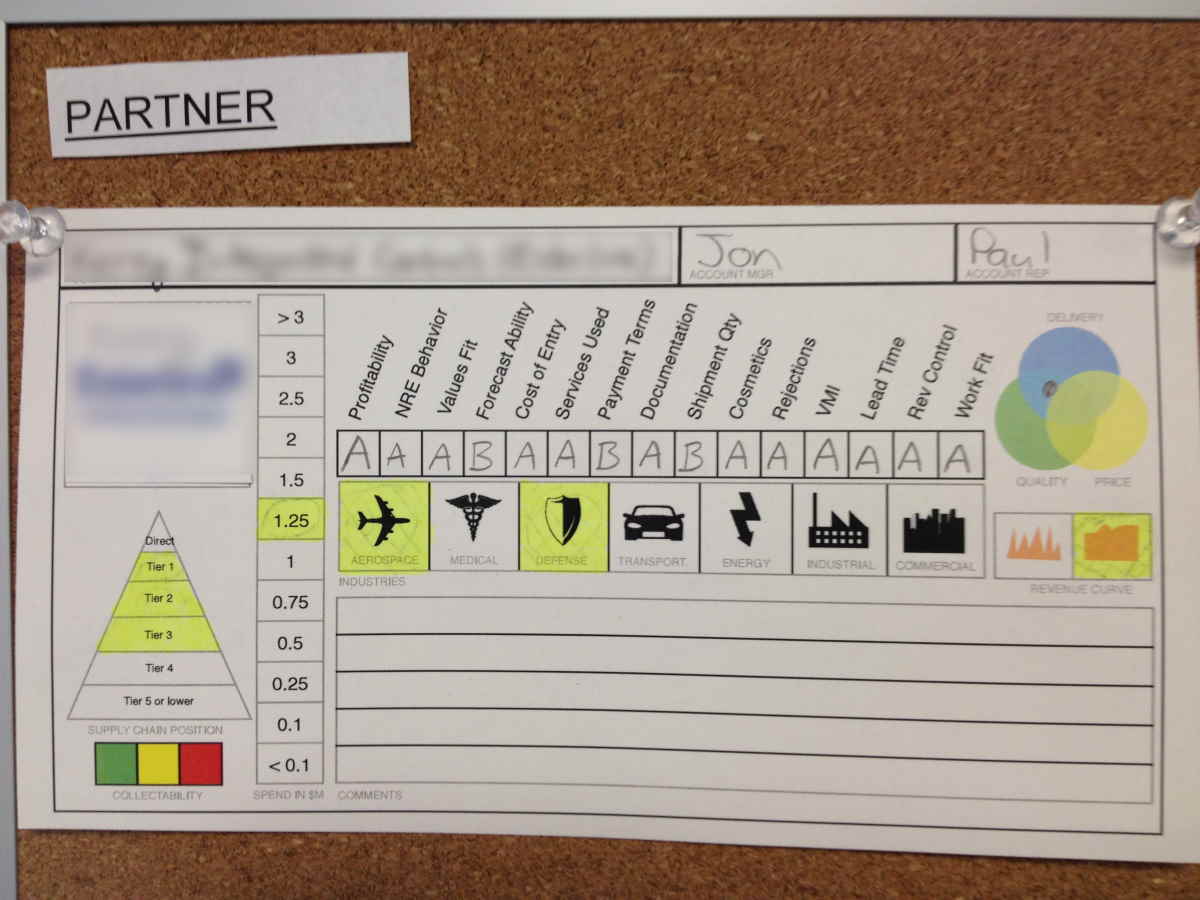
Create Shop Client Scorecards To Prioritize High-Value Clients
On this scorecard you can see the following categories which we graded on an A-F scale. This particular client was one of our largest and best fit clients. They got an A or B in every category.
- Profitability – (Are they highly profitable)
- NRE Behavior (are they willing to pay them)
- Values Fit – (Do they treat us fairly and with kindness)
- Forecast Ability – (Are they pretty good or bad at forecasting deliveries)
- Cost of Entry – (Was it expensive for us to ramp up with them)
- Services Used – (In this case they used many services of ours including milling, turning, assembly, DFM services, etc)
- Payment Terms – (They probably paid Net 30 and always on-time)
- Documentation – (Are their models, drawings, POs, BOMs, clean, or a mess?)
- Shipment Quantity – (Are their shipments of reasonable value or do they want us to send them 1 pc that costs $20)
- Cosmetics – (Do the cosmetic requirements of their parts fit our strengths)
- Rejections – (Is their receiving inspection process well run, fair and reasonable, or do they reject things we believe are within specifications)
- VMI – (Do they rely on us a good amount for Vendor Managed Inventory)
- Lead Time – (Do they order on the lead times we quote, or always less than our quoted lead time)
- Rev Control – (Do they send us “new” rev drawings with the same revision printed on the drawings or not)
- Work Fit – (size, material, complexity, tolerances, etc)
Share Shop Client Scorecards With The Team
As I watched the video I saw myself addressing our team at one of our monthly all-company staff meetings. I shared how many clients, while generally acknowledged as a PITA (pain in the ass), were very profitable overall. We shared with the team why it’s important to understand which clients drive profit in your shop. Then, we highlighted how this knowledge improves team alignment and establishes trust between the sales department and the shop.
I described how grading and categorizing these clients helped us understand what made a good fit client for us. Thus, we could proactively seek out other similar clients. While this process certainly takes effort and is a long term project, it’s definitely worth doing. It eventually leads to having a greater percentage of great fit clients, filtering out ones who aren’t a good fit. Every shop knows the resource drag to manage a client who isn’t a good fit. It’s exhausting and distracts you from serving your best clients!
Grading Clients for any kind of Company
As an aside, we’ve done a similar thing here at ProShop (every type of company should grade their clients). We identify the shops who are a great fit for us, and ones we don’t want to work with. There are many reasons why it matters so deeply that we only work with good fit clients. Primarily we want to have them be happy and successful. And it’s very hard on our team when it’s not a good fit.
We’d much rather turn down an order than create a poor experience. For us, the best alignment comes from the subjective side rather than the objective side of the equation. We know we’re great at CNC machining companies who are in regulated industries like aerospace, defense and medical. But it’s possible to have a company that fits those criteria perfectly, but is a terrible fit overall. Should a shop’s leadership be misaligned, or lack discipline to complete critical tasks, it’s not a good fit for ProShop.
When the cultural fit isn’t there, it’s best to avoid those deals with a 10 foot pole. Everyone will be happier in the long run. Here are the qualities that our best fit clients exhibit.
- They are eager
- Aligned
- Accommodating
- Friendly
- Humble
- Open to learning
- Adaptable
- Interested in continuous improvement
- Good communicators
- Have reasonable expectations
- Interested in LEAN concepts
- Prioritize waste reduction
- Well organized
- Good at execution
- Collaborative
- Not adverse to change
- Not adversarial
We created a whole webinar on this topic, check it out below!
How Can ProShop Help?
Not all of these attributes crossover with an ERP system. Nevertheless, some must be tracked in your ERP system. Revenue and profitability is certainly one of the most important, and ProShop does job costing better than any other system we’ve run across. It’s easy to get Net Profit of every job, down to the penny, and summarize what clients are the most profitable
You can also view a dashboard of revenue by client, and by industry, so you can see which clients and industries your revenue is coming from. It’s also very straightforward to report which clients have the most rejections, internally and externally so you can more easily score clients in these areas. Keep notes on individual contacts within ProShop. Create a top secret notes area that’s only visible to certain users. Use this section to shield more sensitive information about each client.
Prioritize identifying, scoring and finding more clients that are a good fit for your business. You’ll build relationships with happier clients, happier employees, and a more profitable business. So start with developing some criteria that matter most to your shop and see how your clients rank. It’s the first step to getting well aligned with great fit clients!