



Written by: Paul Van Metre and David Vuyk
If you could build the manufacturing business of your dreams, what would it look like? What sort of skills and competencies would need to exist within your team in order to arrive there one day?
The goal of building a world-class manufacturing team is a commendable one. At the same time, so many manufacturing businesses today struggle to make their vision a reality.
Why is that so? To be sure, it’s never just one thing that gets in the way, but a cocktail of challenges that makes progress a daily struggle. Since there’s no magic bullet to overcome this, you can align on overarching goals to increase your growth and profitability. If you want to know the answer, keep reading.
How to Build a World-Class Manufacturing Team
It’s difficult for shop owners and managers to see the hurdles obstructing business growth while managing day-to-day challenges. I’m reminded of a shop whose new 5-axis mill sat idle for months, because an employee left the company. Since that employee was the only one who knew how to operate that machine, tribal knowledge obstructed growth.
In that case, a piece of equipment meant to make revenue for the business was doing the opposite instead, all because of a lack of training and competency on the team. Perhaps you can think of similar examples in your own shop. A lack of training or skilled personnel meant jobs weren’t quoted correctly. Moreover, critical skills and competencies didn’t exist on the team, costing new business opportunities.
How much opportunity are you leaving on the table because you don’t have an effective training and career development program in place to grow that skill from within?
In Jim Collins’ well-known book “Good to Great,” he makes reference to something he calls the “Stockdale Paradox.” Perhaps you are familiar with it.
How does the Stockdale Paradox Foster Continuous Improvement?
To paraphrase, Collins made an observation about the companies he studied who had achieved incredible results. They had the ability to maintain a perspective of duality when confronting business challenges. On the one hand, they were able to confront the harsh reality of their situation, while at the same time being unwavering in their commitment to attaining their objectives.
Apply that concept to your own quest for greatness as a company. Until you do, those struggles will likely continue. In our observation of growing manufacturing businesses, it’s often the shops that can effectively connect their team to achieving those big-picture goals, that experience the biggest wins and resulting momentum. To achieve the same, you also need to be extremely clear on how to build an effective team, whereby you have the right people on board who are equipped and enabled to achieve those incredible results.
Employee Onboarding: Key to Effective Communication, Team Cohesion, Production Efficiency
How can you create an extremely effective new-employee onboarding process? Can you effectively upskill existing employees to fill the gaps you’ve identified? How do we encourage career development for our entry-level staff? How can we develop existing team members to eventually fulfill leadership positions within the company? Those are good questions to be asking, and for that reason, we’ve concluded that having an effective learning management system (LMS) integrated into your overall business management system, is of extreme importance to your long-term success. If there were a magic bullet, that’d be it.
At ProShop, we believe that having your training and learning management system integrated with the rest of your business systems is pretty darn important. If you don’t currently have a system in place, here are a few points to keep in mind:
1. Take a holistic view of the organization
Consider your organizational goals, and how individual team members contribute in different ways to achieving those goals. Doing so will identify in greater clarity the unique roles, responsibilities, and which team members have the competency and skill to complete the specific tasks required. It will also identify the gaps. This will highlight training requirements and the need to increase the critical competencies among the team beyond a single team member. Bolstering those weak points will improve your business as a whole.
2. Build a robust training program for all company positions
Outline core responsibilities and tasks within your organization. Make it simple and accessible. Doing so will aid in the onboarding of new talent, and provide a roadmap to those seeking to advance their career.
Having this system in place will also ease the burden on management, as employees are able to self-serve from the training system, which should hold the answers to most job-related questions. This is a great way in which manufacturing businesses can combat the skilled labor shortage, and ProShop makes that easy with its training and task modules discussed in more detail below.
3. Empower your employees to seek out opportunities for advancement
Employees will feel more confident and comfortable when they see a path forward toward a more advanced role. Taking this approach will empower them to climb the ladder. If your team members can’t connect their daily job duties with the overall goals of the organization or see a path toward career advancement, you’ll experience low engagement and you might lose them altogether. Nobody wants that.
How ProShop can help:
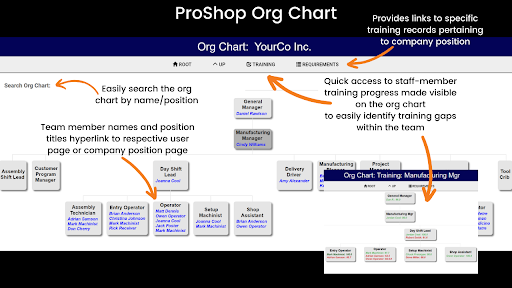
The best starting point is to define your organizational chart and define each company position with its respective roles and responsibilities. An example of ProShop’s org chart feature can be seen in the graphic below.
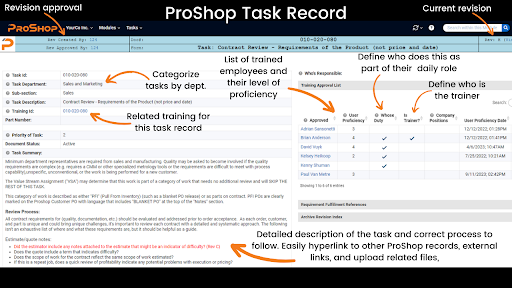
For each role, define the tasks that employees are required to complete as part of their daily duties. An example ProShop task record can be found below.
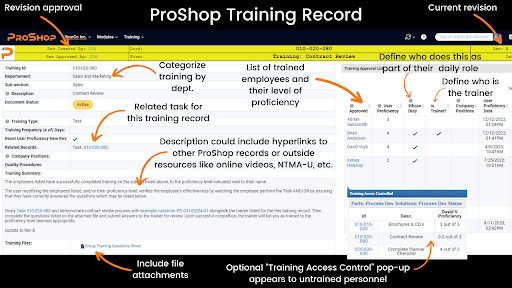
Next, create a training record for each task which outlines the correct way to complete that task, and assign a responsible trainer who can review and approve employee proficiency. ProShop’s optional training access control feature allows certain functions in ProShop to be restricted based on training and proficiency status. An example training record can be found below.
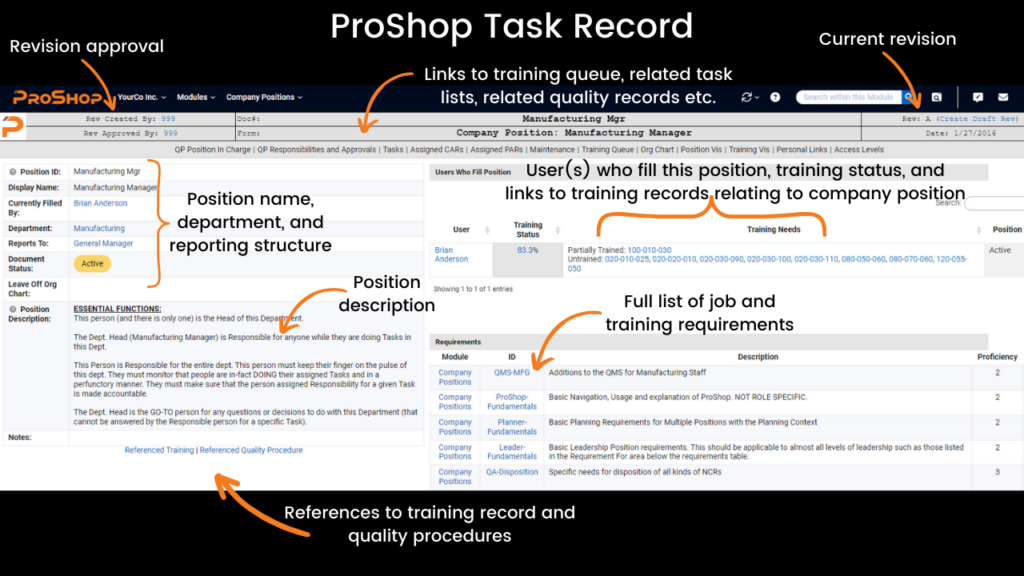
So much clarity is attained when we have defined company positions and an organizational chart that pulls together documented task and training requirements. As you can see in the example below, ProShop’s company position page is a hub whereby team members can access critical information pertaining to their role.
Our goal is to help you build a world-class manufacturing team! Will your current ERP system support your overall business objectives? If not, we’d love to speak with you. Get in touch today to take the first step to making your vision a reality.